How to Calculate Manifold Heater Wattage Correctly
The Foundation of Thermal Stability
For injection molding professionals, temperature control is everything. If your manifold system is too cold, the plastic freezes. If it is too hot, the material degrades.
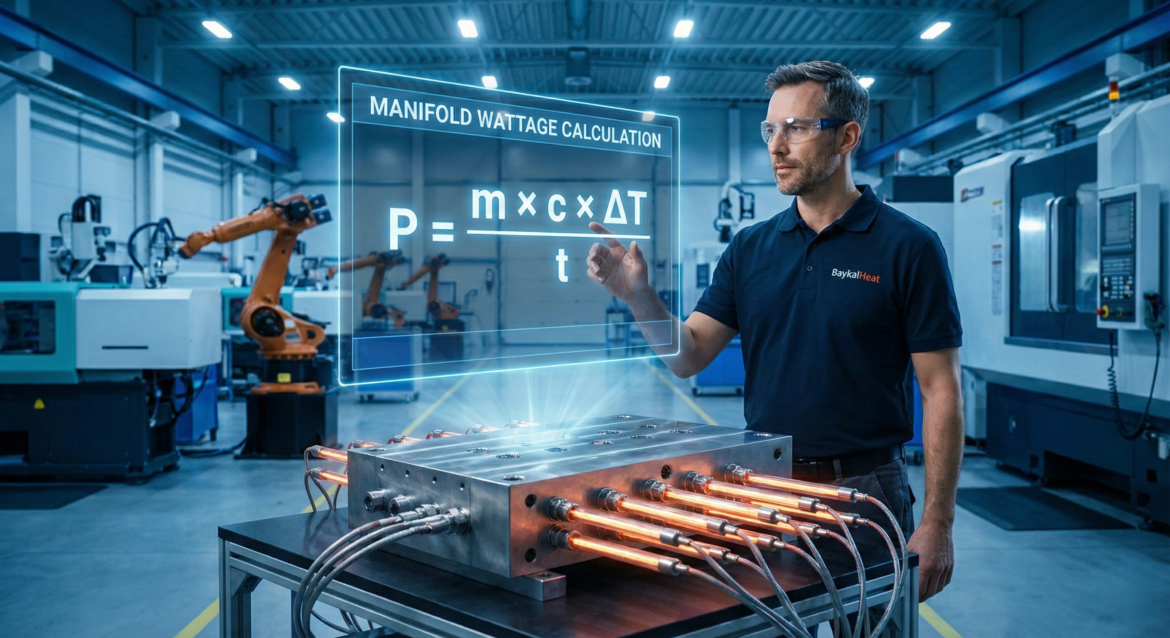
The secret to perfect balance lies in one critical step: the Manifold Heater Wattage Calculation.
Many engineers rely on rough estimates. However, guessing your heating requirements leads to inefficient production and heater failure.
At Baykal Heat, we believe in precision. This guide will provide you with the exact formulas and engineering principles needed to calculate the correct power (Wattage) for your system. We have structured this guide to give you the answer immediately, followed by the deep technical details you need for optimization.
The Calculation Formula
Do you need the math right now? Here is the core formula used by thermal engineers worldwide.
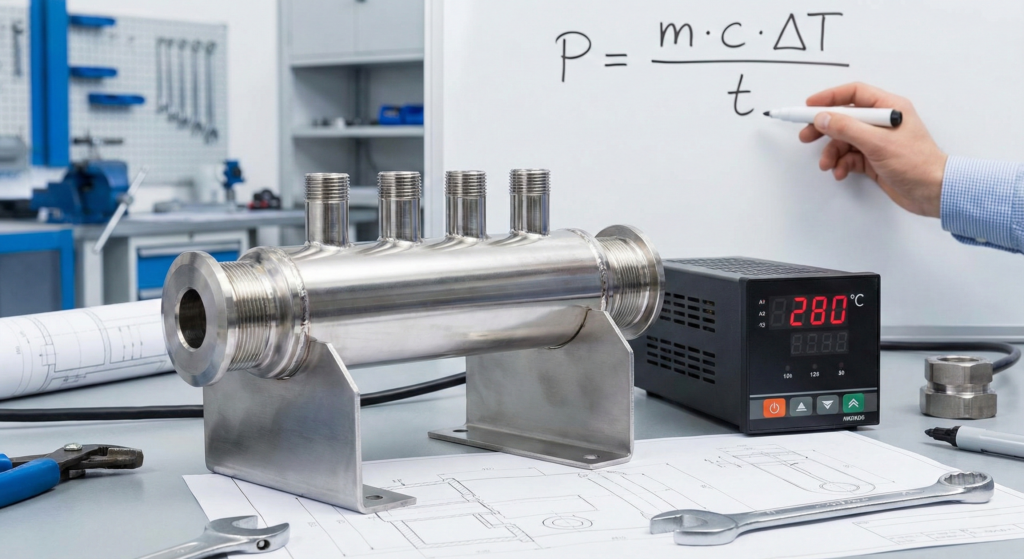
To find the required Kilowatts (kW), use this equation:
Understanding the Variables
- Mass (m): The total weight of the manifold steel (kg).
- Specific Heat (c): The heat capacity of the steel (Typically 0.46 kJ/kg°C for steel).
- Temperature Rise (ΔT): Target Operating Temp minus Ambient Room Temp (°C).
- 3600: The conversion factor from seconds to hours.
- Time (t): Desired heat-up time (Usually 0.5 to 1.0 hours).
- Safety Factor (SF): Multiplier for heat losses (Typically 1.2).
In summary: Multiply the mass, specific heat, and temperature difference. Divide the result by the time (in seconds), and add a 20% safety margin.
Step-by-Step Calculation Guide
Calculating wattage is not just about plugging numbers into a calculator. You must understand what those numbers represent in the physical world. Let’s break down the process into manageable steps.
Step 1: Determine the Mass of the Manifold
First, you need to know exactly how much steel you are heating. Do not guess the weight.
Calculate the volume of your manifold block (Length × Width × Height). Then, multiply that volume by the density of the material. For standard P20 tool steel, the density is approximately 7.85 g/cm³.
Pro Tip: Don’t forget to include the weight of the nozzles and sprue bushings if they are being heated by the same zone. They add thermal mass to the equation.
Step 2: Define Your Temperature Differential (ΔT)
How hot does the system need to be? This depends on the polymer you are processing.
Start with your target processing temperature. For example, Polycarbonate might require 280°C. Then, subtract the ambient room temperature of your factory (usually 20°C).
The resulting 260°C is your ΔT. This is the “hill” your heaters must climb.
Step 3: Choose the Heat-Up Time
This is a critical decision. Everyone wants the machine ready quickly, but “faster” is not always “better.”
A standard heat-up time is 30 to 45 minutes.
If you try to heat a massive block of steel in 10 minutes, you will require an enormous amount of power. This creates a risk of “overshoot,” where the temperature flies past the set point, potentially burning the plastic.
At Baykal Heat, we recommend a balanced approach. Design your system for a 45-minute startup. It is safer for the steel and extends the life of the heater.
The Importance of the Safety Factor
You calculated the theoretical power. Now, you must add the “Real World” variable.
In a laboratory, a heater is perfectly insulated. In a factory, it is not. Your manifold is bolted to the mold plates, and those plates are bolted to the machine platens.
Huge amounts of heat are sucked away from the manifold through conduction. Additionally, heat is lost to the air via convection.
Applying the 20% Rule
To compensate for these losses, we apply a Safety Factor.
We typically multiply the theoretical result by 1.2 (or add 20%).
For example, if the math says you need 4000 Watts, you should actually install 4800 Watts. This extra headroom ensures the heaters don’t have to run at 100% duty cycle just to maintain the temperature. It allows the PID controller to regulate the heat smoothly.
Watt Density: The Hidden Danger
This is the most common reason for heater failure. You might get the Total Wattage correct, but if you get the Watt Density wrong, the system will fail.
Watt Density is the amount of power coming out of every square centimeter of the heater’s surface (W/cm²).
If you try to pump 2000 Watts through a very short, small heater, the density will be too high. The internal resistance wire will melt before the heat can transfer into the steel.
Limits for Manifold Heaters
- Standard Fit: 3 to 4 W/cm².
- Precision Fit: Up to 5 W/cm².
- Pressed-in Square Profile: Can handle higher densities due to better contact surface.
Always check the surface area of your heater. If the calculation requires high wattage, use a longer heater or use multiple heaters to distribute the load.
Electrical Voltage Considerations
Voltage fluctuates. This is a fact of industrial life.
Remember that Power (P) equals Voltage squared divided by Resistance (V² / R).
If you design a heater for 220 Volts, but your factory runs on 240 Volts, the heater will generate 20% more power than you calculated. This could push the watt density into the danger zone.
Conversely, if the voltage drops, your heat-up time will drag on, causing production delays. Always measure the actual voltage at the machine before ordering heaters from Baykal Heat.
Why Manifold Insulation Matters
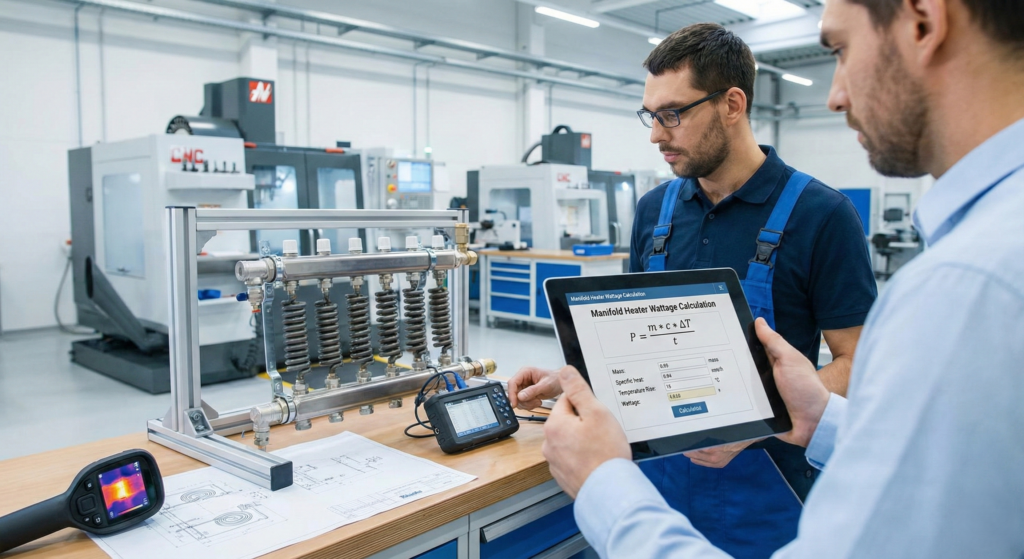
Even with the correct wattage calculation, an uninsulated manifold is an energy waster.
Without insulation boards (like ceramic or composite shields), your manifold acts like a giant radiator. You are essentially heating the factory air instead of the mold.
Proper insulation does three things:
- Reduces Energy Bills: Cuts power consumption by up to 40%.
- Improves Consistency: Protects the manifold from drafts and temperature swings.
- Extends Heater Life: The heaters work less to maintain the set point.
Installation Tolerances: The Final Piece
You can have the perfect calculation and the perfect heater, but if the installation is poor, it will fail.
Manifold tubular heaters rely on conduction. They must be physically touching the steel.
The groove in your manifold must be machined to precise tolerances. If the groove is too wide, air gaps form. Air is an insulator. The heat will stay inside the heater, burning it out, while the manifold remains cold.
Baykal Heat Recommendations
- Groove Shape: Ensure the groove matches the heater profile (Round or Square).
- Clamping: Use clamping plates to press the heater firmly into the groove.
- Cleanliness: Remove all oil and carbon deposits before installing a new heater.
Why Choose Baykal Heat?
At Baykal Heat, we don’t just sell resistors; we sell thermal solutions.
We understand that the Manifold Heater Wattage Calculation is just the beginning. Our engineering team considers the steel type, the flow path, the polymer characteristics, and the cycle time.
We produce heaters with:
- Optimized Watt Density: Designed for longevity.
- High-Purity MgO: For superior thermal transfer.
- Precision Bending: To fit even the most complex manifold geometries.
Don’t leave your production to chance. Trust the experts who understand the physics behind the heat.
Need Help with Your Calculation?
Are you designing a new mold or retrofitting an old one? Let us double-check your math.
Contact Baykal Heat Engineering Team Today
We will help you select the exact power, profile, and installation method to ensure your production runs flawlessly.
Frequently Asked Questions
Q: What happens if my wattage is too low?
A: The system will take too long to heat up. In severe cases, it may never reach the processing temperature, causing the plastic to freeze in the runners.
Q: Can I just use the highest wattage possible?
A: No. Excessive wattage leads to “thermal shock” and makes temperature control difficult. It also shortens the life of the heater.
Q: How often should I replace manifold heaters?
A: With correct wattage calculation and installation, heaters can last for years. Frequent failures usually indicate incorrect watt density or poor installation.
Q: Does Baykal Heat offer custom heater shapes?
A: Yes. We can form heaters to any 2D or 3D geometry required by your manifold design.
Leave a Reply