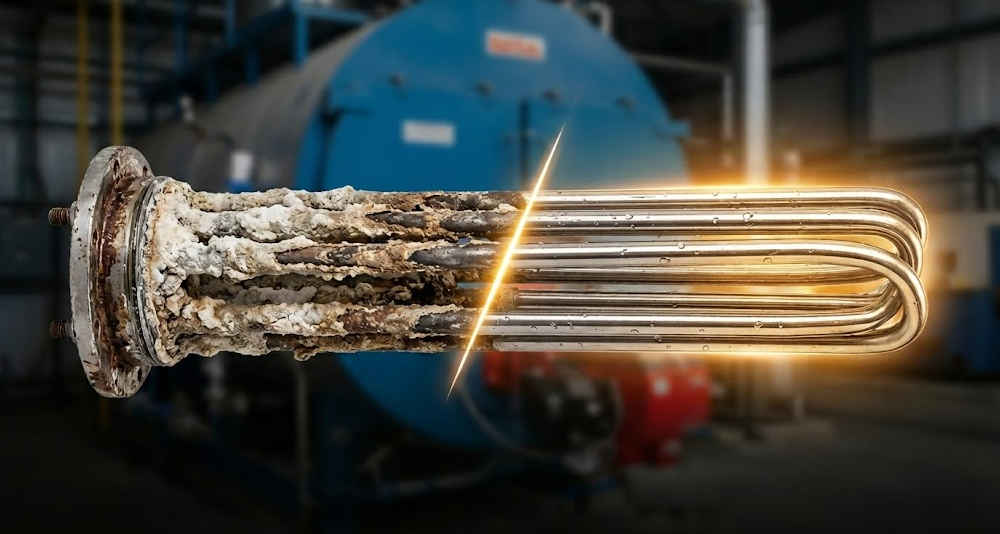
In the world of industrial process heating, whether in large-scale boilers, chemical baths, or commercial water heating systems, the premature failure of heating elements is a costly and recurring nightmare for facility managers. The vast majority of these failures are often wrongly attributed to electrical manufacturing defects or “bad batches.” However, detailed failure analysis consistently reveals a different culprit: a fundamental mismatch between the water’s chemical composition and the heater’s “Watt Density” (Surface Load).
The question frequently asked by maintenance teams—“Why do our heaters burn out every three months, even though we buy premium quality?”—is answered by the physics of thermodynamics. The villain is the thermal insulation effect created by limescale buildup (scaling) on the element’s sheath. This guide delves deep into the mechanisms of scaling, the science of heat transfer, and the engineered solutions that Baykal Heat has pioneered since 1970 to eliminate these failures.
1. The Thermodynamics of Failure: How Scale Kills Heaters
To understand why scaling is lethal to immersion heaters, we must look at how calcium carbonate ($CaCO_3$) behaves in water. Unlike most substances (like sugar or salt) that dissolve better in hot water, calcium carbonate has “inverse solubility.” This means as water gets hotter, it holds less calcium. Consequently, the minerals precipitate out of the water and deposit onto the hottest surface available: the metal sheath of your heating element.
Once this scale forms, it acts as a potent thermal insulator. Scale has a very low thermal conductivity compared to metal. Here is the chain reaction of failure:
- Heat Trapping: The element generates heat, but the scale layer prevents it from transferring into the water.
- Temperature Spike: The energy has nowhere to go, so it backs up into the core of the heater. While the water might be only 60°C, the internal wire temperature can spike above 1000°C.
- Dielectric Breakdown: The magnesium oxide (MgO) insulation inside the tube degrades under this extreme heat, losing its electrical insulating properties.
- Catastrophic Failure: The internal wire melts (open circuit) or the outer sheath ruptures due to thermal expansion, causing a short circuit to the water.

2. The Engineering Solution: “Low Watt Density” (LWD) Technology

The most critical parameter in designing a long-lasting heater for hard water is Watt Density. This is defined as the amount of power (Watts) dissipated per square centimeter of the heater’s surface area.
High Watt Density vs. Low Watt Density
Standard commercial heaters are often designed with High Watt Density (10-15 W/cm²). They are small, cheap, and powerful. However, their surface temperature is extremely high, which “bakes” minerals onto the tube instantly. In hard water areas, these heaters are destined to fail within months.
Baykal Heat’s approach utilizes Low Watt Density (LWD) technology (typically 4-8 W/cm²). By using longer elements, larger diameters, or coiled designs for the same power rating, we drastically increase the surface area. The result is a heater that runs “cooler” at the surface while still delivering the total required energy to the tank. On a cooler surface, scale cannot adhere aggressively and often flakes off as soft sludge, settling harmlessly at the bottom of the tank.
3. Metallurgy Matters: Selecting the Right Alloy
Not all stainless steel is created equal. The corrosion resistance of the heater sheath is paramount, especially when scale creates an environment for “under-deposit corrosion.”
- AISI 304 Stainless Steel: The industry standard. Adequate for clean, treated water but vulnerable to pitting in chloride-rich or stagnant hard water.
- AISI 316L Stainless Steel: Contains molybdenum, offering superior resistance to chlorides and acidic environments. A better choice for food processing and mild chemical applications.
- Incoloy 800 / 825: The gold standard for industrial heating. These high-nickel superalloys provide exceptional resistance to oxidation, carburization, and high-temperature corrosion. For critical applications, Baykal Heat strongly recommends Incoloy.
- Titanium: The only viable solution for saltwater or highly corrosive brine applications.
4. The Ultimate Defense: Teflon (PTFE) Coated Heaters
For industries dealing with extremely aggressive chemicals (like acid pickling baths) or water with extreme hardness, metal alloys may not be enough. This is where fluoropolymer (PTFE/Teflon) technology comes into play.
Baykal Heat manufactures specialized heaters coated with a non-stick PTFE layer. Just like a high-quality frying pan, this surface is chemically inert and inherently non-stick. Scale simply cannot bond to the fluoropolymer surface. It slides off, ensuring that the heater operates at peak efficiency for years with virtually zero maintenance. While the initial investment is higher, the ROI (Return on Investment) is substantial due to the elimination of downtime and replacement costs.
5. The Hidden Cost of Downtime (ROI Analysis)
Many procurement departments make the mistake of buying the cheapest heater available. Let’s analyze the true cost. A standard $50 heater might fail 4 times a year. A custom-engineered Baykal Heat LWD heater might cost $150 but lasts for 3 years.
However, the real cost isn’t the hardware; it’s the production downtime. If a heater failure stops a production line valued at $1,000 per hour, a 4-hour replacement window costs the company $4,000. In this context, investing in a properly engineered, low-watt-density heater is not an expense—it is an insurance policy for your production continuity.
6. Installation & Maintenance Best Practices
Even the best heater can be destroyed by poor installation. Follow these guidelines to maximize lifespan:
- Avoid “Dry Firing”: This is the #1 cause of immediate failure. Ensure your system has a low-level float switch interlocked with the power supply. If the water level drops, the heater must turn off instantly.
- Cold Zones: Baykal Heat designs heaters with “Cold Zones” (unheated sections) at the bottom. This ensures that even if sludge accumulates at the bottom of the tank, the heated part of the element is not buried in sediment, which would cause overheating.
- Sensor Placement: Place your thermostat sensor at a reasonable distance from the heater to get an accurate bulk water temperature reading, preventing short-cycling.
- Chemical Cleaning: Never use abrasive tools (wire brushes, hammers) to clean scale. This damages the passive oxide layer of the stainless steel. Use approved chemical descaling solutions instead.
Conclusion: Engineering Over Economy
Industrial heating is not a commodity; it is a science. Fighting scale requires a strategic combination of Low Watt Density design, superior metallurgy (Incoloy/Teflon), and intelligent control systems. Don’t let scale dictate your maintenance schedule.
Contact Baykal Heat today for a technical consultation. Let our engineering team calculate the precise surface load required for your specific water chemistry and design a heating solution that lasts.
اترك تعليقاً